Architecture overview
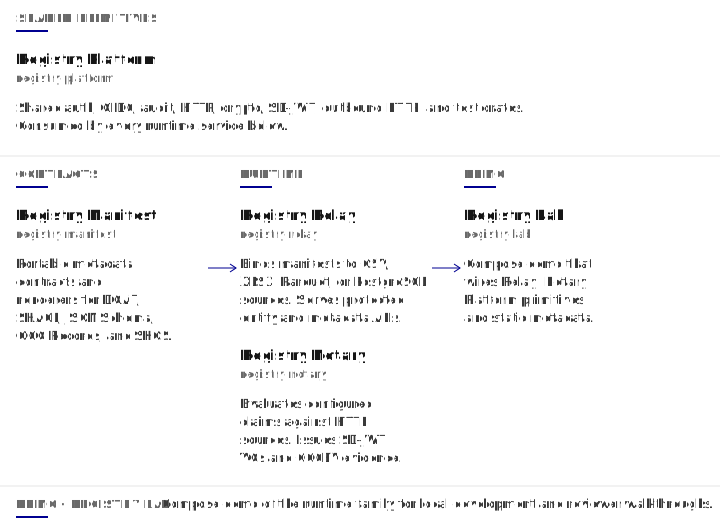
The registry stack is organized around two layers: a portable metadata layer and a runtime services layer. The metadata layer (Registry Manifest) compiles and renders discovery artifacts that describe what a registry exposes, without touching production sources. The runtime services layer (Registry Relay, Registry Notary) binds those artifacts to real data, enforces access control, evaluates claims, serves delegated evaluation between trusted Notaries, and issues credentials. Registry Platform provides shared Rust primitives consumed by both runtime services. Registry Lab runs the current stack together in a local demo.
These docs cover the five current formal stack projects: Registry Platform, Registry Manifest, Registry Relay, Registry Notary, and Registry Lab.
At runtime, Registry Stack exposes source data through two patterns:
- Protected Registry APIs are controlled read-only interfaces over existing registry sources. Registry Relay implements this runtime surface.
- Evidence Gateway is the governed evidence path. A runtime service evaluates request context, source context, supported policy terms, freshness, redaction, and audit provenance before it returns a result or denial. Registry Notary implements claim evaluation and credential issuance. Registry Relay implements governed read routes when evidence is returned from a protected API.
This split matters because it separates the obligation to describe (what a registry declares it can expose and under what policy) from the obligation to enforce (what a running service will actually return to an authorized caller). A reviewer can audit the portable metadata bundle before any runtime service is deployed. An integrator can validate schemas and claim shapes offline. A governance team can publish updated policy documents without touching deployment config.
Data and contract flow
Section titled “Data and contract flow”- Registry Platform provides reusable security and operational primitives consumed by runtime services.
- A metadata manifest (
registry-manifest/v1schema) describes datasets, entities, fields, policies, and evidence offerings. - Registry Manifest compiles and validates the manifest, then renders a static discovery bundle
(catalog, DCAT, BRegDCAT-AP, CPSV-AP, SHACL, JSON Schemas, OGC Records item collection,
policies, evidence-offering metadata, embedded codelist metadata, and an
index.json). - Registry Relay starts with runtime config that binds the manifest’s logical datasets and entities to actual data sources. Clients reach entity routes, metadata routes, and evidence-offering endpoints through configured auth.
- Registry Notary evaluates claims against configured HTTP sources (
registry_data_api,dci, or source adapter sidecar connectors, with the sidecar using built-inhttp_json,http_flow, orfhirengines to reach external sources such as DHIS2 or FHIR servers). It renders evaluation results asapplication/vnd.registry-notary.claim-result+jsonor CCCEV-shaped JSON-LD (application/ld+json; profile="cccev"), and it materializes eligible stored evaluations into SD-JWT VC credentials (application/dc+sd-jwt). - A trusted Registry Notary can call another trusted Registry Notary through
POST /federation/v1/evaluationsfor signed delegated evaluation. Registry Manifest can publish discovery metadata for that relationship, but local Notary peer policy grants access. For what each project does and does not own, refer to the product overview pages linked in the table below.
Capabilities at a glance
Section titled “Capabilities at a glance”The two-layer design supports one capability sequence: describe what the registry can provide, expose protected registry APIs, then return evidence that matches the purpose and policy of the request. A caller cannot safely use a registry until its fields, schemas, services, policies, and evidence offerings are inspectable, so metadata comes first.
| Capability | Use it when | Primary project |
|---|---|---|
| Describe registries | Other teams need to inspect fields, schemas, policies, services, and evidence offerings before integration. | Registry Manifest |
| Protected Registry APIs | A file, extract, database, or legacy registry needs a governed read-only API without replacing the source. | Registry Relay |
| Evidence Gateway | A caller needs a status, predicate, selected value, redacted result, protected read, denial, or supported credential instead of unrestricted source-record access. | Registry Notary and governed Registry Relay routes |
Shared audit and operational behavior makes Registry Relay and Registry Notary reviewable: Registry Platform supplies the shared primitives for authentication, HTTP security, audit envelopes, cryptography, and credential support that both runtime services compose. Registry Lab gives reviewers a runnable local topology for the current stack.
- Evidence issuance explains claim evaluation, disclosure policy, delegated evaluation, and credential issuance in Registry Notary.